Judith Green, Reader in Sociology of Health, London School of Hygiene & Tropical Medicine: Identity and the city – what your choice of transport says about you (1st May 2012)
Presentations from all previous Street Talks are available here.
Judith Green, Reader in Sociology of Health, London School of Hygiene & Tropical Medicine: Identity and the city – what your choice of transport says about you (1st May 2012)
Presentations from all previous Street Talks are available here.
Reducing urban speed limits makes streets safer and more pleasant places to be – helping to encourage walking and cycling, revitalise local high streets and reduce air pollution.
8.5 million people around the UK (including 1.5 million in London) already live in local authorities with a policy of rolling out 20mph limits on most roads. These include cities such as Oxford, Cambridge, York and Liverpool, and the whole of Lancashire.
This masterclass will explore the reasons why implementing 20mph across London makes sense and consider how to successfully campaign for lower speed limits on streets where people live, work and shop.
Rod King and Jeremy Leach from 20’s Plenty for Us will outline the wide range of social, economic and environmental benefits of 20mph and explain how its 189 local campaigns are transforming the way our roads are shared; and Caroline Russell from Islington Living Streets will explain how and why Islington became the first borough in London to implement 20mph on all their streets.
7pm on Wednesday 1st May at 3Space Blackfriars, 58 Victoria Embankment, EC4Y 0DS.
The masterclass is free but space is limited, please register here if you’d like to attend.
This event is part of 3Space’s Re:Think Festival and is being held in association with Living Streets and 20’s Plenty for Us.
Street Talks with Ashok Sinha and Richard Lewis, London Cycling Campaign: Love London, Go Dutch – how we can make our streets as safe and inviting for cycling as they are in Holland (3rd April 2012)
Presentations from all previous Street Talks are available here.
Jim Davis, Chair, Cycling Embassy of Great Britain – The Joy of Sects: The Evolution of the Embassy
Two years after his first appearance, Jim Davis, Founder and Chair of the Cycling Embassy of Great Britain returns to Street Talks in April to reflect on why he decided to set up a new campaign, the problems the Embassy has faced in moving amongst the cycling establishment, cycling enthusiasts and national government, and the fun they’ve had along the way.
Jim will discuss what the Embassy stands for and the challenges that they may face in the future. He will consider how they can help ensure the Mayor and his successors deliver on the Vision for Cycling in London, and whether London can act as an inspiration for investment in cycling infrastructure across the UK.
Jim Davis is a writer, campaigner, lobbyist, occasional blogger and even more occasional stand-up comedian. He founded the Cycling Embassy of Great Britain in January 2011 having campaigned locally and worked for CTC as an Information Officer.
Upstairs at The Yorkshire Grey, 2 Theobalds Road, WC1X 8PN at 7pm on Tuesday 9th April 2013 (bar open from 6pm).
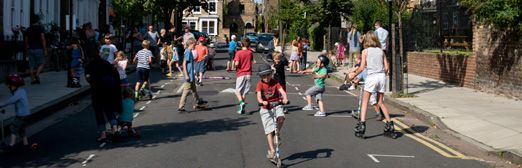
Photo: Hackney Council
A guest article by Jono Kenyon.
People are constantly amazed when I mention I live on the same road I grew up on. Something about London seems alien to the concept. Either you grew up here, then promptly upped sticks the moment you had a family, or you moved here at some point in life. For me, fate and luck brought me back to the same street I played on as a boy. Many of the local roads adjacent to Seven Sisters Road were closed off to through traffic in the early eighties to curb prostitution. This was an incredibly successful strategy, and it also led to a better street environment. My brother and I played in the street regularly, despite there being the huge Finsbury Park less than 100 metres away.
So here we are, 20 years later, and things have changed. It’s rare to see children playing in front of their houses with other kids from the street. Children are spending more time indoors or being shepherded from one structured activity to the next. In many parts of London, people don’t know their next door neighbours, let alone any other families on their street. I often wondered whether we could ever rekindle the old sense of community and see children out playing as I used to. Then two things happened. We had a street party, instigated by some neighbours we had never met, and I read a piece in the Guardian about a scheme called ‘Playing Out’, started in Bristol, aimed at encouraging street play. It struck a chord with me. We want our children to trust the space outside our home. We want them to get to know the people we live near, not just next door to. We would like to generate a sense of community, rather than waiting for one to magically come about. At the street party, we found many people that we live amongst, but had never met, who felt the same way.
So what stops us from just opening our doors and letting the kids roam free? Cars. Despite the gates, vehicles continue to travel in a fashion unlikely to encourage kids to play naturally in the street. Drivers just don’t expect to encounter anyone or anything on the 200-metre zip up the road. Playing Out offered a way to begin to take back some ownership of the space outside our homes.
Essentially the idea is to formally close a street to through traffic to allow children to play. Giving children the freedom to play in the street allows them to form relationships with kids they don’t go to school with. Younger children can bond with older ones too. Unstructured playtime allows children the opportunity to gain independence from their parents. Kids make up their own games with their own rules and ultimately resolve their own conflicts without adult interference. In addition, Playing Out helps to develop a sense of community in the street. We had a lot of support, not just from the parents of children playing, but also from childless and elderly neighbours. Our experience of other sessions elsewhere in Hackney was that many people simply came out to have a cup of tea and a chat with others.
So how did we organise the first of our 12 playing out sessions this year? I attended an evening workshop given by Alice Ferguson, who co-created the Playing Out concept. The workshop outlined why Playing Out was a good idea, and ran through the procedures required to get it going. Our road had a great head start as two other neighbours came to the workshop. The three of us got together and began the process. A great deal of the groundwork had been done by others including local resident Claudia Le Sueur Draper who had organised with Hackney council to facilitate the sessions. The council were encouraged to start a 12 month trial to allow the granting of temporary road closures for street play, or TPSO.
We leafleted the whole street to introduce the idea and find more support. We then had to go through a formal consultation process, notifying all residents of our intended 2-hour road closures. Once that was completed, Hackney supplied us with formal notices and some ‘Road Closed’ signage. Volunteers strung up bunting across each end of the street and stewarded these entry-points, slowly escorting through any residents’ cars and turning away all other traffic.
Our first session was for 2 hours last Sunday, and was great, albeit cold! What struck me was how little encouragement the kids need. We didn’t need to worry about them being bored at all. As soon as the barriers went out, it was ‘game on’. Neighbours came out to offer cups of tea and home-baked treats.
Ultimately, I would like the formal side of Playing Out to fade away in our street, as well as neighbouring ones. I would like the 6 roads that make up our network here, to become a safe zone for street play. It would be nice for cars entering residential streets across the UK to know that children may well be in the road, and should take priority.
Lots of information is available on the Playing Out website.
This is a write up of Bruce McVean’s The New City lecture given on Monday 11th February 2013 at Cambridge University’s Department of Architecture.
A brief (and over simplified) history of transport and the city
Cities have always been shaped by transport, while the planning and design of cities impacts on transport choices. The first cities were inherently walkable – the primary mode of transport was people’s feet and cities were necessarily compact in size and form as a result.
Public transport allowed cities to grow well beyond a size that would allow a person to comfortably walk from one side to the other. The expansion of train, tram, bus and tube lines helped suburbia spread, but the component parts of suburban growth remained walkable – homes needed to be within walking distance of train stations, tram stops, bus routes, shops and services. Today we’d say that cities were expanding through ‘transit orientated development’.
Mass private transport came in the form of the bicycle, which enabled people to travel further for journeys not served by public transport, bringing new personal freedom of movement that helped whet the appetite for the even greater freedoms promised by the car.
Aspirations towards car ownership were matched with aspirations towards home (and garden) ownership. After the Second World War rising car ownership freed developers from the need to provide easy access to public transport. Shops and services no longer needed to be within walking distance. Aggressive lobbying by car manufacturers, government investment in road building, and changes in planning policy and development economics all helped fuel the rise of the car as the transport mode of choice.
Now those who live in suburbia have little choice but to drive – trapped in a vicious cycle of car dependency as the separation of land uses continues to place jobs and services beyond the reach of those on foot, while low densities make the running of decent public transport nigh on impossible – and most people looking for a new home have little choice but to buy in suburbia.
Of course, it wasn’t just suburbia that was being shaped by the car. In existing urban areas perfectly functional buildings and even neighbourhoods disappeared under the wrecking ball to provide the road and parking space necessary to bring the car into the heart of the city.
The problem with cars
The negative impacts of our love affair with the car have long been acknowledged. As have the difficulties of trying to do anything meaningful to address them. In 1960 the Ministry of Transport commissioned a team led by Colin Buchanan to look at the problem, resulting in the publication of Traffic in Towns in 1963. 50 years on the project steering group’s famous acknowledgement that, “We are nourishing at immense cost a monster of great destructiveness. And yet we love him dearly…” still rings true.
Undoubtedly many people still aspire to car ownership, or view owning a car as essential to maintaining a high quality of life. And who are we to deny them? Engines keep getting more efficient and electric cars will help wean us off carbon dioxide emitting toxic fossil fuels. What about those self-driving cars we keep hearing so much about? Aren’t they going to use road space so efficiently that congestion will be a thing of the past, along with crashes? Perhaps, but what kind of city do we want to live in? One where everyone zooms about in their own metal box, completely removed from their fellow citizens? Ask anyone how they think their city can be improved and the answer is unlikely to be more cars – self-driving or otherwise.
Technology may soon address the problems of the internal combustion engine and the contribution that car travel makes to carbon emissions and air pollution; but technology alone can’t solve the myriad of other negative impacts of car dependency that are neatly summarised in the diagram below from the Royal Commission on Environmental Pollution’s report The Urban Environment. Tackling carbon emissions and air pollution is an essential task, but it’s not the only task – the big villain isn’t the internal combustion engine, it’s the car. As Taras Grescoe argues in Straphanger, “The automobile was never an appropriate technology for [cities]. As a form of mass transit for the world, it is a disaster.”
Anna Minton, author of Ground Control – Fear and happiness in the twenty-first century city (6th March 2012)
Presentations from all previous Street Talks are available here.
Living Streets work to create streets that really put people first. When we have streets we want to walk in, lives are transformed – we are healthier, happier and more sociable. Living Streets Local Groups make a real difference by campaigning on the issues that matter in their local area.
We’re partnering with Living Streets to launch their new Westminster Living Streets Group on Tuesday 12th March . We’ll be joined by Sir Terry Farrell, one of the world’s foremost urban planners and architects, who will be sharing his vision for a more people friendly Westminster. We hope you can join us too.
6.30 for 7pm, 12th March at Terry Farrell and Partners, 7 Hatton Street, NW8 8PL. Directions here (pdf).
During forty years in practice, Terry Farrell has transformed London’s skyline and animated the banks of the Thames with his Charing Cross and MI6 headquarters buildings. It is, though, through his long-term involvement in the region’s urban planning – through specific projects, as well as through advocacy and initiating public debate – that Farrell has made his greatest contribution . He is currently the government champion for the planning of the Thames Gateway and advises the Mayor of London on his Design Advisory Committee.
If you would like to know more please contact Tom Platt at Living Streets – tom.platt@livingstreets.org.uk
Tim Gill, Rethinking Childhood: There’s a salmon in my street – the outdoor child as an indicator species for the quality of urban environments (7th February 2012)
Presentations from all previous Street Talks are available here.
Rachel Aldred – The Case Against the Car
Rachel Aldred is a Senior Lecturer in Transport at Westminster University and the founder of the London Cycling Research Group. In this talk she will put the ‘Case Against the Car’, exploring some of the socio-economic, political, health, environmental and cultural harms of automobile dependency, as well as outlining some current trends offering reasons for hope.
Upstairs at The Yorkshire Grey, 2 Theobalds Road, WC1X 8PN at 7pm on Tuesday 5th February 2013 (bar open from 6pm).
Rachel is a sociologist working in the area of transport, focusing particularly on issues around cycling, mobility cultures, transport justice, and transport modelling. Her research projects have covered cars and CO2, cycling cultures in England, cycling advocacy in London, and modelling social influences on commuting decisions. Rachel has written for academic and non-academic publications, spoken at a wide range of academic and non-academic events, and has been invited to give expert evidence to the GLA’s Cycling in London investigation and the All Party Parliamentary Inquiry ‘Get Britain Cycling’. She has recently been elected to the board of the London Cycling Campaign.
 Movement for Liveable London