From the archives: Tom Barry’s Street Talks Presentation

Tom Barry, Boris Watch: State of the city – the highs and lows of London transport policy 2000 – 2011 (8th March 2011)

It’s almost a year since Boris Watch’s Tom Barry kicked off Street Talks. Here’s his analysis of Ken Livingstone and Boris Johnson’s track record on transport, a very handy summary as we appraoch a Mayoral election in which transport is likley to be a key issue.

Presentations from all previous Street Talks are available here.

March’s Street Talk

Anna Minton, author of Ground Control – Fear and happiness in the twenty-first century city

London has been transformed by development and regeneration projects in recent years, many of them privately financed. With public purse strings held tight is private sector investment now essential to the creation of a more liveable London? Is there a price to pay for a public realm that is increasingly owned or managed by private companies and watched over by CCTV? Have Business Improvement Districts, mega shopping malls, gated residential and commercial developments, even the Olympic Park led to regeneration and rejuvenation, or have they intensified social divisions and made us more fearful of each other?

We hope you can join us and Anna Minton, author of Ground Control for March’s Street Talk to explore the impact of private ownership and control of urban spaces and places on public life.

Upstairs at The Yorkshire Grey, 2 Theobalds Road, WC1X 8PN at 7pm (bar open 6pm) on 6th March.

Anna Minton is a writer and journalist. She spent a decade in journalism, including a stint as a corporate reporter on the Financial Times, and is the winner of five international journalism awards. Finding daily journalism frustrating she began to focus on longer projects for think tanks and policy organizations. Ground Control emerged from a series of agenda setting reports, two of which were published by the Royal Institution of Chartered Surveyors and the other by the think tank Demos. The first focused on gated communities and ghettoes in the US, questioning to what extent these trends are emerging in the UK. The second looked at polarization and culture in one British city, Newcastle, and the third investigated the growing privatisation of public space.

A City of 20

A guest article from Tom Platt, London Coordinator, Living Streets

How we might work towards a safer, more liveable London is a topic debated energetically at each month’s Street Talks.  Whether it is the pros and cons of shared space or the practicalities of segregated cycle lanes, the desire is to create a safer London where people feel comfortable to walk, cycle and spend time. Yet the fact remains that last year alone, 65 pedestrians and 16 cyclists were killed on the capital’s streets.  So what can be done?

Living Streets is the national charity working to create safe, attractive and enjoyable streets around the UK. In our opinion the single biggest change we can make to creating a more liveable London is to reduce vehicle speeds across the capital.

That’s why this year in the lead up to the London mayoral elections Living Streets, Sustrans and a coalition of 27 other prominent organisations are asking for mayoral candidates to commit to introducing 20mph on parts of the mayoral controlled streets where we live, work and shop in our campaign a City of 20.

Simply put, if you get hit by a car driving at 30 mph you are much more likely to get seriously injured or killed than at 20 mph. If fact a pedestrian struck at 20 mph has a 97% chance of survival whilst at 30 mph the figure is 80%, falling to 50% at 35 mph.

In London, Transport for London (TfL) found 20 mph limits to have cut fatal and serious casualties by almost a half. Applying results from previous TfL research to the four hundred 20 mph zones London has today suggests an equivalent of 192 killed and seriously injured casualties are already being prevented each year.

So far most 20mph campaigning in London has focused on residential streets and near to schools. We strongly support this and are calling for the next Mayor of London to inspire and encourage local authorities to follow Islington’s example by implementing a default 20 mph speed limit on all residential streets.

However we also know that around a third of London’s collisions are happening on those streets controlled by the Mayor (the TLRN) and that’s despite it only making up 5% of the street network.  The reason the City of 20 campaign is focusing on parts of the TLRN where we live, work and shop is simple -that’s where the biggest impact can be made.  By first tackling those streets where the greatest risk of conflict arises we can make the greatest benefit to people’s everyday lives. These are community centres and local high streets – the streets where people live, walk to school and go to their local shops.

Of course 20 mph doesn’t just make our streets safer, it also makes for better streets where people are more likely to walk and cycle. Unsurprisingly, in Europe 30km/h (18mph) speed limits are the foundation of cycling and walking policies in Denmark, Belgium, Germany, Netherlands, Norway and Sweden.

Importantly 20 mph can be implemented at low cost, and is easy to do. Portsmouth converted 1,200 streets in the city to 20mph for a cost of just over half a million pounds. Prior to this, they had been planning to spend £2 million on ten targeted 20 mph zones over five years. New government legislation makes it now possible to introduce 20 mph limits without expensive roads calming measures. In fact the cost of road casualties suggests a sound economic argument for 20mph simply with the amount casualties it will prevent, with the DfT estimating that a road fatality costs in the region of £2 million.

There simply is no excuse for the entirety of the TLRN to be exempt from 20 mph. Already other main roads such as the Walworth Road in Southwark have a 20 mph limit. Islington has recently announced plans to expand 20mph from residential to all main roads in the borough.  Getting London to be a truly world class city for walking and cycling is a huge challenge but 20 mph speed limits on the streets where we live, work and shop would be an excellent start. Please join the campaign by writing to the future Mayor of London today.

For any enquiries about the City of 20 campaign, please contact Tom Platt on 020 7377 4900 or email tom.platt@livingstreets.org.uk
February’s Street Talk

Tim Gill, Rethinking Childhood: There’s a salmon in my street – the outdoor child as an indicator species for the quality of urban environments

Picture the place where you grow up. How did you get around? Where did you play as a child, and hang out as a teenager? Now imagine children growing up today in that same area. How do you think their experiences would compare with yours?

It is often said that kids today grow up faster than they used to. As a statement about their everyday freedoms, nothing could be further from the truth – as we know from the seminal work of Mayer Hillman on children’s independent mobility. Anxious parents are often blamed for this shift to a more captive childhood. Yet parents have to deal with the environment that is around them. For decades, transport and planning policies have worked against creating the kind of compact, liveable neighbourhoods that help parents to untie the apron strings.

The everyday lives and neighbourhoods of city children were a key focus of the work of great urbanists like Jane Jacobs (who devoted a whole chapter of Death and Life of Great American Cities to the topic) and Kevin Lynch (who, after his seminal Image of the City, went on to spearhead UNESCO’s international Growing Up in Cities programme in the 1970s). Recent years have seen lively debate about both the future of cities and the changing nature of childhood. Yet there have been few serious attempts to join the dots.

Tim Gill argues that this has to change. Join us for February’s Street Talk to explore why children’s everyday freedoms matter: to them, to communities, to policy makers and to the planet. Just as with the salmon or the house sparrow, children’s presence in public space should be seen as an indicator of the quality of their habitats. Is the outdoor child becoming an endangered species?

Upstairs at The Yorkshire Grey, 2 Theobalds Road, WC1X 8PN at 7pm (bar open 6pm) on 7th February.

Tim Gill is one of the UK’s leading thinkers on childhood. His work, which focuses on children’s play and free time, has a real, positive impact on children’s everyday lives. His influential book No Fear: Growing up in a risk-averse society was published in 2007. His consultancy clients include Barnardos, the Forestry Commission, the National Trust, Argent plc and the Olympic Park Legacy Company, amongst others. He appears regularly in the mainstream and specialist press, and on broadcast media. Tim blogs at his website, rethinkingchildhood.com.

January’s Street Talk – full details

Stuart Reid, Director of Sustainable Transport and Communities, MVA Consultancy: Creating successful shared space streets

The difference between a street and a road is that a street must fulfil a range of functions above and beyond merely acting as a corridor for traffic. Streets are places and social spaces.

The concept of shared space seeks to improve the way a street functions as a place by reducing segregation between pedestrians and vehicles and minimising traffic related signs, signals and street furniture. It is an approach that challenges the assumption that separating pedestrians and vehicles always improves safety, instead aiming to create an environment that encourages drivers, pedestrians and cyclists to behave in a more co-operative manner.

Pioneered by the Dutch it is increasingly popular in the UK with schemes such as Exhibition Road raising the profile of shared space in recent years. It is however a design approach and philosophy that is not free from controversy. Questions have been raised about the impact of removing crossings and kerbs on blind and partially sighted people, about driver behaviour and whether this approach to street design is seen as a panacea that allows local authorities to claim they are putting the needs of pedestrians first without necessarily taking significant steps to reduce traffic volumes and impacts.

For the first Street Talks of 2012 we will be joined by Stuart Reid, Director of Sustainable Transport and Communities at MVA Consultancy to consider what makes a successful shared space street. Are the champions of shared space overselling the benefits or are the naysayers overstating the risks? Isn’t it all just a question of context? If so, where and when is shared space appropriate?

Upstairs at The Yorkshire Grey, 2 Theobalds Road, WC1X 8PN at 7pm (bar open 6pm) on Tuesday 10th January.

Stuart Reid is a prominent figure in the field of sustainable transport, with a particular interest in walking and cycling. He has contributed to the development of national policy and key guidance for planning, process and design and has worked on behalf of central and local Government clients including the Department for Transport, Department for Communities and Local Government, Highways Agency, Countryside Agency and Transport for London as well as numerous local authorities.

Saving Soho

A guest article from Mark Stanley, Saving Soho

In many ways, Soho is the historic heart of London. It’s home to the capital’s café culture, creativity, design and the evening economy.

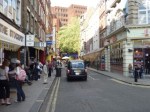
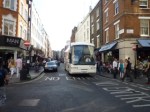
But this unique character is slowly and steadily being eroded with excess, speeding traffic. Soho, with its intimate, high density feel and narrow streets was never designed to accommodate such heavy volumes of rat-running traffic.

In London, we should be creating a city that we can be proud of, which is fit for 21st century life. With the capital’s population steadily increasing, creating quality environments will be key to the future success of the city. A unique place like Soho with so many opportunities deserves better treatment, to maximise its assets.

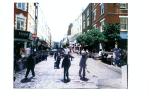
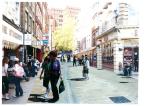
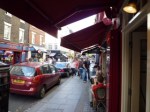
For too long now, the streets and lanes of Soho have been dominated by traffic, while pedestrians have been relegated to narrow overcrowded pavements and are forced to overspill onto the carriageway. The narrow pavements make things particularly difficult for people with disabilities or those with prams and pushchairs. The area’s footways are simply not wide enough to accommodate wheelchairs. Imagine the legacy for London’s Paralympics Games if all visitors, including wheelchair users, were able to visit and enjoy Soho. The time is long overdue for equal priority to be given to pedestrians.

Instead of being a quality neighbourhood, Soho has become an embarrassment to London. Every other city in the UK or indeed the world would have long since taken action to reduce the impact of rat-running traffic in such an exceptional but sensitive area. Instead of being able to relax and enjoy the area’s uniqueness, pedestrians come second to cars, forced to use narrow pavements while traffic benefits from wide lanes and 30mph speed limits, which are way in excess of acceptability in such a sensitive location.

The results of all of this traffic are accident rates much higher than those expected for secondary and tertiary streets such as these. In the past two years alone, there were 44 serious traffic accidents reported to the police. Accident hot spots include Wardour St, Great Marlborough St, Old Compton St and Brewer St (Dept of Transport figures).

The lifeblood of Soho comes from those who live and work here, and visitors coming to eat and drink here. The area gains little or nothing from speeding through traffic. Workers, residents and visitors to Soho are being urged to push for Westminster Council to help rid Soho’s narrow streets of some of the unnecessary traffic. A new campaign ‘Saving Soho’ is aiming for pedestrians to get the priority, instead of an environment that is dominated by traffic.

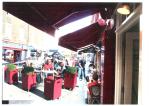
Imagine having some decent space outside a café to enjoy a meal without the constant drone of traffic. The campaign is not calling for permanent pedestrianisation of the area. Instead, pedestrian priority works are advocated which would continue to allow traffic, but re-prioritise people over cars. This includes:

  • Traffic calming and speed restrictions to deter rat-running.
  • Pavement widening and kerb build outs to reallocate space in favour of shoppers and visitors.
  • Part time pedestrianisation of certain busy areas, for specific peak times only, such as weekends, or evenings. (Both the North Laines in Brighton and Copenhagen have successfully operated such schemes for decades).
  • Possible closure of some roads – but only to through traffic – so access remains for residents, businesses and deliveries.

Some of the benefits of pedestrian priority works in Soho include:

  • Reduced speed and less traffic mean fewer accidents.
  • More space for leisurely shopping and dining means more visitors, increased turnover and more profits for businesses.  Space could be available for more outdoor restaurant seating and tables.
  • Less traffic, less traffic noise, less traffic pollution.
  • The works could be cheap to implement, e.g. a road closure or a bollard to prevent through traffic would have minimal cost.
  • Minimal disruption to residents and businesses. Continued deliveries for businesses (at certain times only), and ongoing access for residents would be permitted.
  • Improved environment and quality of life. More space for al-fresco living.
  • Sufficient access provided for wheelchair users.
  • Soho is a designated conservation area, with dozens of listed buildings; it has a high density, “enclosed” character – unique for London. The distinctive character of Soho as a working historic neighbourhood is being eroded, and action is needed to redress the balance from vehicles to pedestrians.

More details of the Saving Soho campaign are available at savingsoho.co.uk. A petition has also been launched seeking immediate action from Westminster Council to safeguard this unique area, help deliver the long overdue improvements that Soho deserves and create a city centre that Londoner’s can be proud of.

December’s Street Talk – The word from the street

7pm on 6th December 2011 at Look Mum No Hands, 49 Old Street, EC1V 9HX (in aid of RoadPeace)

At December’s Street Talk the following speakers will each have 7½ minutes to present their ideas for creating a more liveable London:

The first talk will start just after 7pm. Look Mum No Hands will be open as usual beforehand.

We’ll be collecting money for RoadPeace on the night, you can also make a donation here.